美国白宫——材料基因工程官网
MGI Homepage | Materials Genome Initiative
An official website of the United States government
Case report
Discovery of high-entropy ceramics via machine learning
Although high-entropy materials are attracting considerable interest due to a combination of useful properties and promising applications, predicting their formation remains a hindrance for rational discovery of new systems. Experimental approaches are based on physical intuition and/or expensive trial and error strategies. Most computational methods rely on the availability of sufficient experimental data and computational power. Machine learning (ML) applied to materials science can accelerate development and reduce costs. In this study, we propose an ML method, leveraging thermodynamic and compositional attributes of a given material for predicting the synthesizability (i.e., entropy-forming ability) of disordered metal carbides. The relative importance of the thermodynamic and compositional features for the predictions are then explored. The approach’s suitability is demonstrated by comparing values calculated with density functional theory to ML predictions. Finally, the model is employed to predict the entropy-forming ability of 70 new compositions; several predictions are validated by additional density functional theory calculations and experimental synthesis, corroborating the effectiveness in exploring vast compositional spaces in a high-throughput manner. Importantly, seven compositions are selected specifically, because they contain all three of the Group VI elements (Cr, Mo, and W), which do not form room temperature-stable rock-salt monocarbides. Incorporating the Group VI elements into the rock-salt structure provides further opportunity for tuning the electronic structure and potentially material performance.
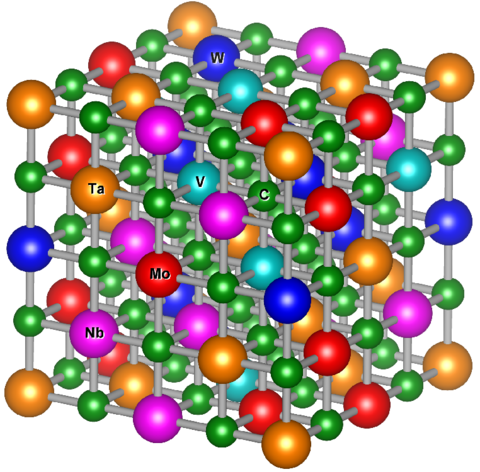
A high-entropy carbide HEC-16: MoNbTaVWC5 that forms a single phase with spark plasma sintering. It was designed, synthesized, and tested using MGI-facilitated strategies. See https://www.nature.com/articles/s41524-020-0317-6
.
Credit: Duke University